Here’s a conversation that happens more often than you’d think. A business owner opens ChatGPT, types in something related to their industry, and sees their brand name in the answer. They screenshot it. They send it to their team. Everyone gets excited.
Then someone asks: “So should we start investing in generative engine optimization now?”
It’s a fair question. But before the answer is yes, there’s a more important question to settle first.
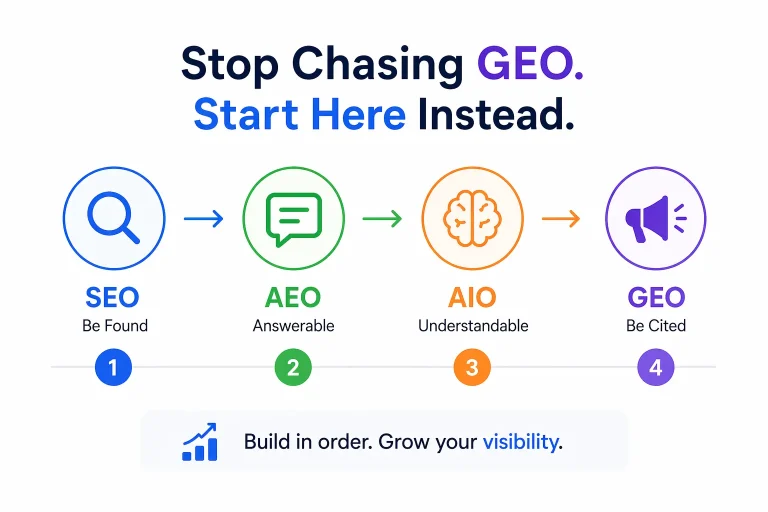
The Visibility Ladder
You cannot skip to layer 4 without the layers beneath it being stable first.
“ChatGPT Already Mentions Us” — So What Does That Actually Mean?
Why some brands get cited before they’re ready
Some brands get picked up by AI platforms before they’ve done a single day of deliberate GEO work. This usually happens for one reason — brand awareness. If your business has been around long enough, has a strong social media presence, or is widely known in your market, AI platforms may reference you simply because your name appears across enough sources online.
But being known is not the same as being ready. A brand with strong offline or social presence can appear in an AI answer while their website has unranked keywords, low organic traffic, and a technical foundation that hasn’t been properly set up. The AI cited the brand. The website didn’t earn it.
If you want to understand how SEO, AEO, AIO and GEO connect as a system, Stop Chasing GEO. Start Here Instead. is a good place to start.
The difference between a lucky citation and a consistent one
There’s a meaningful gap between being cited occasionally and being cited consistently. When citations happen by accident, the queries that trigger them are scattered — no clear pattern, no identifiable topic, no page you can point to and say “this is what’s working.” It feels good, but it tells you very little.
Consistent citations are different. You start to see patterns — the same topic categories, the same pages being referenced, the same type of questions triggering your brand. That’s when citation becomes a signal worth acting on. Until then, it’s closer to luck than strategy.
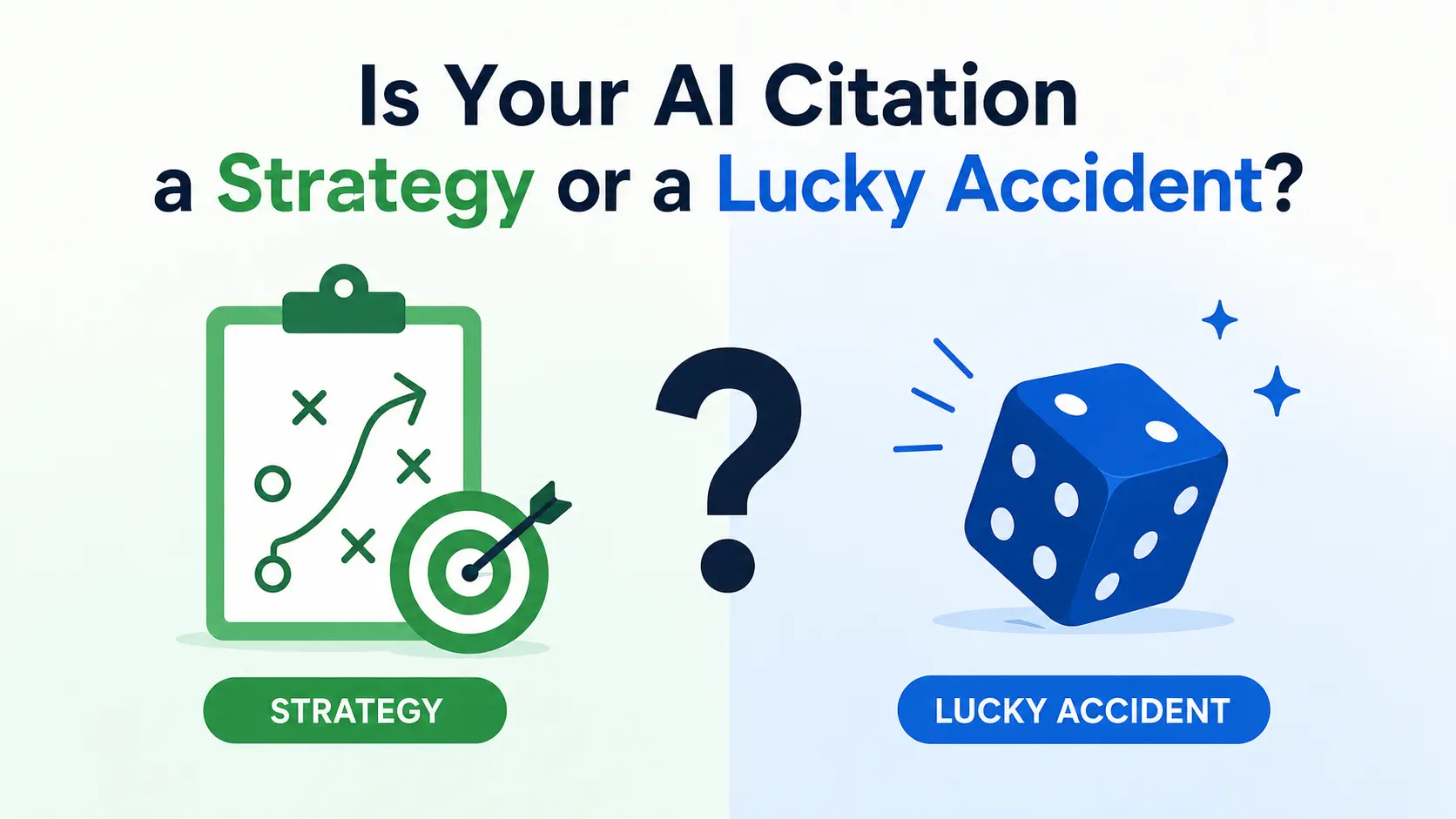
Is an AI Citation a Reliable Signal or a Lucky Accident?
Why GEO citations are harder to track than Google rankings
With Google rankings, the feedback loop is clear. You can see where you rank, which keywords are moving, and how traffic responds. With AI citations, there’s no dashboard. No position number. No click data tied directly to the mention. Generative engine optimization tracking relies on estimation — running prompts manually, using third-party tools with their own limitations, and making educated guesses about what’s driving visibility.
This doesn’t make GEO worthless. But it does mean that a single citation is harder to interpret than a ranking movement. You can’t be certain whether the citation came from your content, your backlinks, your brand mentions across the web, or simply the way a user phrased their question that day — on Perplexity, ChatGPT, or any other AI platform.
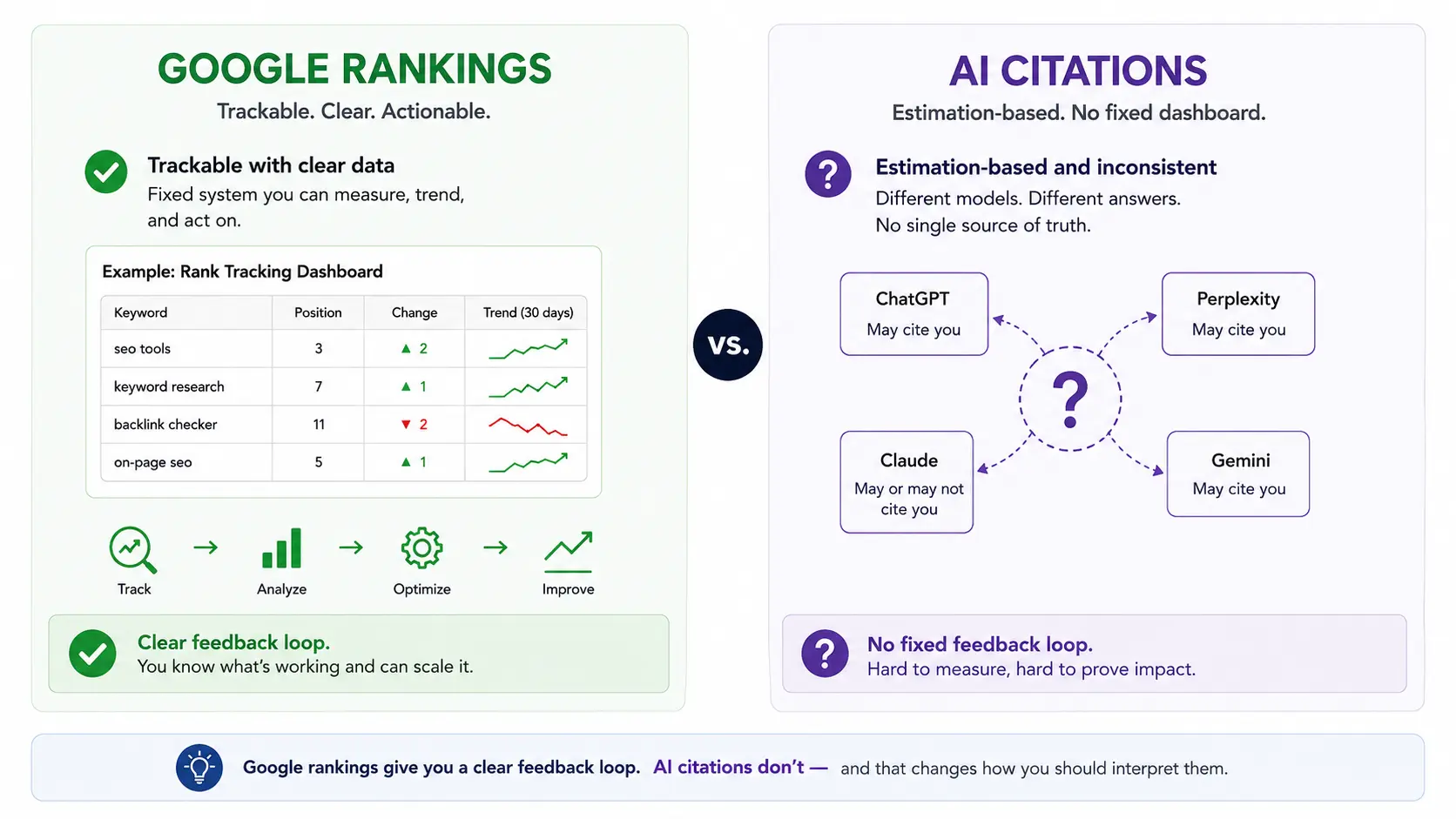
Google rankings give you a clear feedback loop. AI citations don’t — and that changes how you should interpret them.
The gambling analogy — and why it fits better than you’d like
Think of an occasional AI citation the way you’d think about winning at the casino. It happens. It feels great in the moment. But you wouldn’t quit your job and gamble full-time based on one good night.
Gambling can win you money occasionally — but it cannot be treated as a stable monthly income. GEO without a stable foundation works the same way.
You might get cited again next week. You might not. And without the underlying SEO structure to support consistent visibility, there’s no reliable way to build on what you have.
Before You Invest in GEO, Ask These 3 Questions About Your Website
Before committing budget and time to geo generative engine optimization work, assess your readiness honestly across three areas.
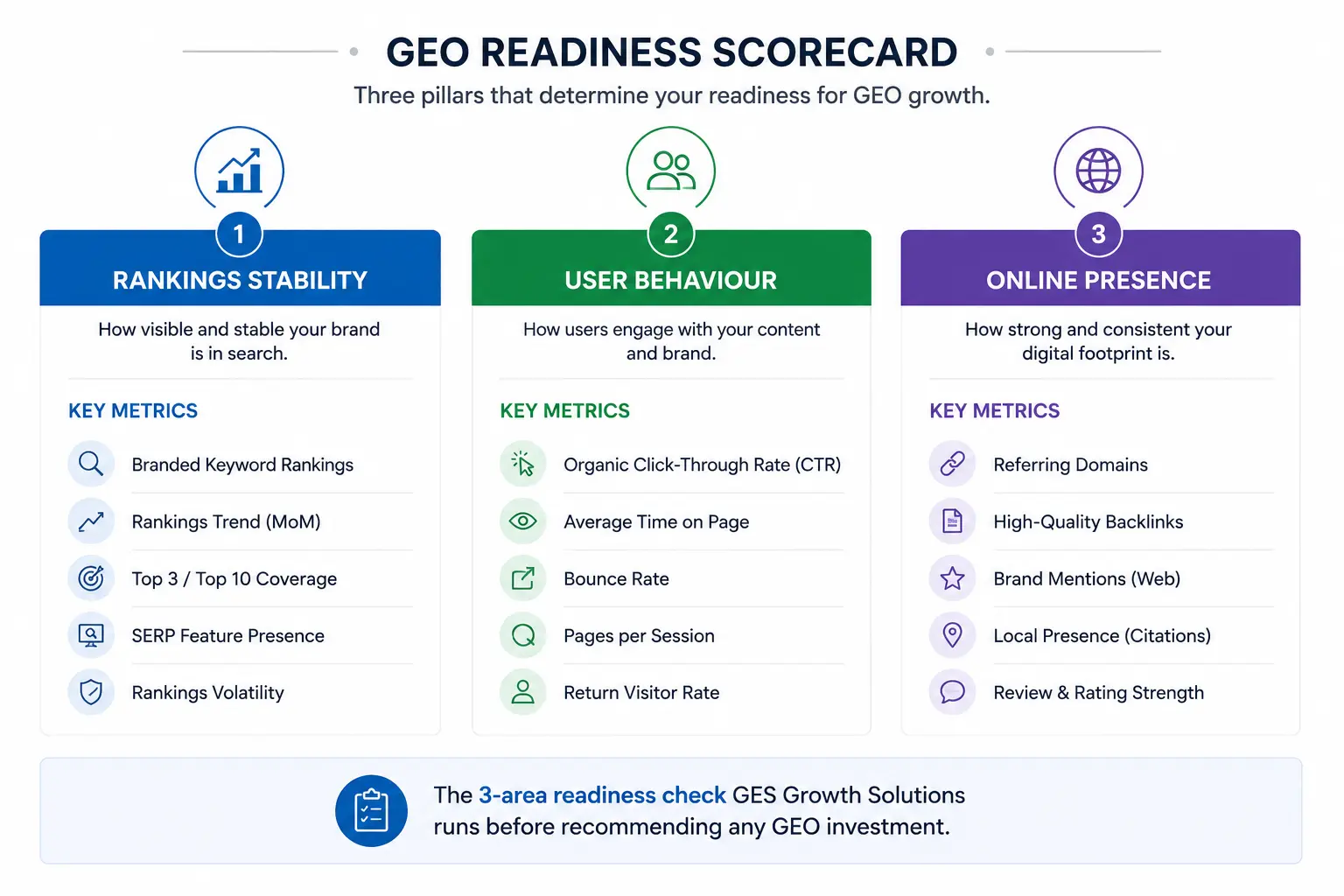
The 3-area readiness check GES Growth Engine Solutions runs before recommending any GEO investment.
Branded and non-branded keywords holding top 20 positions with a healthy and improving CTR.
Traffic growing consistently, with strong engagement rate and session duration — not spiking and dropping.
Active Google Business Profile, consistent social media presence, and backlinks from credible sources across the web — not just your website alone.
When all three are in reasonable shape, your foundation is ready. If even one is missing or unstable, that’s where your focus should go before GEO work begins. For more details on what readiness looks like in practice, a free site audit gives you that picture clearly.
Check If Your Website Is GEO-Ready
What Happens If You Start GEO Without a Stable Foundation?
It won’t get worse — but it will be much harder to get better
Starting GEO early won’t break anything. But it will make everything harder. GEO strategy is built on estimation data — AI platforms don’t publish their ranking criteria the way Google does. Every decision involves a degree of educated guesswork. That’s already a layer of difficulty built into the work.
When your website foundation isn’t stable, you’re adding more uncertainty on top of that. You’re trying to optimise for AI visibility while the search engine optimization signals underneath are still inconsistent. The effort required increases. The results become harder to read. And the return on investment gets pushed further away.
Why an unready website increases GEO workload and reduces returns
High effort, unclear results, harder to measure, ROI pushed further away. Like building a second floor on an uneven ground floor.
Focused work, measurable results, consistent citations that compound over time. Each layer built on something solid.
If you want to understand why SEO results take longer than most people expect, the same logic applies here — rushing the upper layers before the base is solid costs more time and money in the long run.
See How We Build the Foundation
A Citation Is a Signal. A Foundation Is a Strategy.
Getting cited by ChatGPT is exciting. It means your brand exists somewhere in the data AI platforms draw from — and that’s not nothing. But a citation without foundation is like a good night at the casino. It happened. It might happen again. But it isn’t a plan.
At GES Growth Engine Solutions, we help businesses understand exactly where they stand across SEO, AEO, AIO, and GEO — and build in the right order, at the right time. If your current citation feels more like luck than strategy, let’s talk about what it takes to make it consistent.
Ready to Turn Your Citation Into a Strategy?
Find out exactly where your website stands across SEO, AEO, AIO, and GEO — before you invest a single ringgit in GEO work.
Chat With Us on WhatsApp