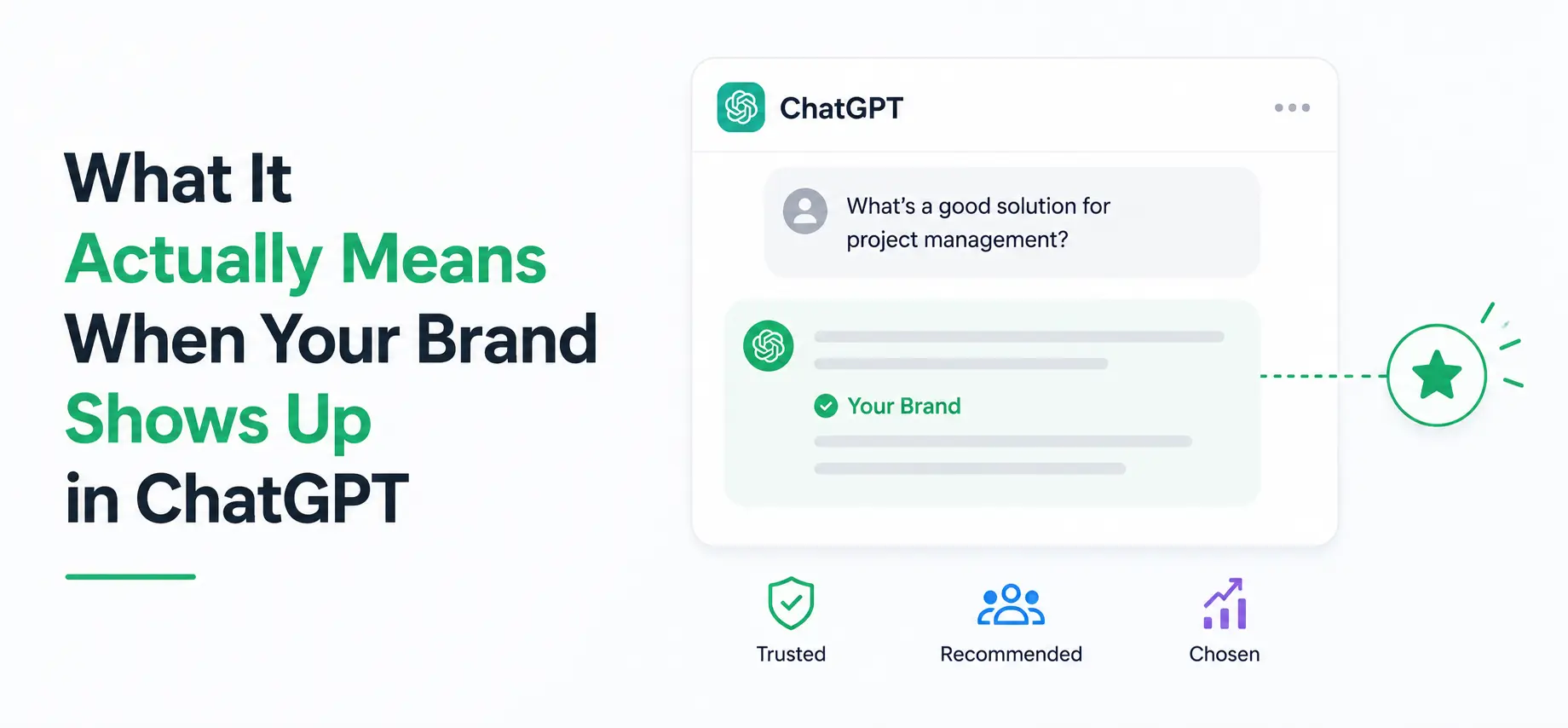
There is a moment most business owners know well. You hear about GEO, you hear your brand should be showing up in ChatGPT, and the first thing you do is open it up and type your company name. Either it appears and you feel relieved, or it does not and you start to worry. Neither reaction tells you very much — because that single check is not how AI visibility actually works for Malaysian businesses.
The Question Everyone Asks First
Why “Just Check ChatGPT” Is Not the Answer
The most common advice online: open ChatGPT in incognito mode, type a question about your industry, and see if your brand appears. It sounds logical. It does not work.
AI platforms operate on probability, not a fixed ranking system. Every response is generated fresh — run the same prompt twice and you will get two different answers.
One check gives you one data point. One data point proves nothing.
If you want to understand why AI visibility takes longer than most people expect, why showing up on ChatGPT takes longer than you think is worth reading before you act on any single check.
What You Actually Need to Know Instead
The right question is not “did my brand appear just now?” It is “how often does my brand appear, across what topics, and how does that compare to my competitors?” That requires structured citation data gathered across many prompts over time — not a single incognito test.
AI Is Not Google. Stop Treating It Like One.
What a Google Ranking Gives You That AI Does Not
On Google, you hold a position. Number four for a keyword — measurable, trackable, relatively stable. Improve your SEO and you move up. You can see it happen.
AI citation does not work that way. There is no ranking page. When someone asks ChatGPT a question, the AI names a handful of brands — and those names change every time. The brands that show up most consistently are the ones AI has encountered most frequently across trusted sources on the web.
Business owners who approach AI visibility the same way they approach Google rankings will always end up confused. The systems are fundamentally different, and the rules that apply to one simply do not apply to the other.
What This Means for How You Measure Progress
You are not trying to reach a fixed position. You are trying to build the kind of brand presence that makes AI more likely to mention you, more often, across more relevant conversations. Frequency and breadth — not ranking. This is also why Google Search Console cannot tell you whether GEO is working. It is a different measurement system entirely.
The mindset shift: You are not chasing a ranking. You are building a frequency — how often AI encounters your brand across trusted sources on the web.
So What Does a Meaningful Check Actually Look Like?
Where to Start
Skip the manual prompt testing. The more reliable starting point is AI citation data from SEO tools like Ahrefs or Semrush — they run prompts at scale across thousands of queries and aggregate the results into patterns you can actually act on. One incognito check cannot do that.
What to Look At
Do not look at your brand in isolation. Look at your brand compared to your top three competitors across the same topic areas. Where are they appearing that you are not? That gap is your most actionable signal — it tells you where the opportunity is, not just where you currently stand.
What the Three Outcomes Mean
When AI is asked about your category, three things can happen:
AI names your brand as a solution when someone asks for help. The strongest outcome — and the hardest to earn.
AI references your content as a source that informed its answer. The most common first outcome for Malaysian SMEs building GEO.
AI answers the question without mentioning your brand at all. Where most businesses start — and the signal that GEO foundation work is needed.
Citation tends to come first for most businesses — driven by whether your content is structured in a way AI can extract and reference. If you are not sure what that looks like, this post on AEO explains the foundation.
If Your Competitor Is Being Cited and You Are Not
The First Question to Ask
Before looking for a technical fix — a content update, a page restructure, a setting to change — ask one question first.
Is your business doing well in the real world?
AI cites brands the wider web already trusts. That trust comes from real customer experiences, genuine reviews, and consistent service quality. If those foundations are not solid, no amount of website optimization creates AI visibility that has not yet been earned. The algorithm reflects reality — it does not manufacture it.
Why On-Site and Off-Site Signals Are Connected
GEO is not a website strategy. It is a comprehensive digital presence strategy. Your website, reviews, social media, PR, and community mentions all feed into the picture AI builds of your brand. On-site and off-site are not separate tracks — they are the same track, working at different touchpoints. Do the real work well, and let your customers provide the signal AI needs to find you.
What to Do When Your Brand Is Not Showing Up
Do Not Optimize Blindly
Changing content, restructuring pages, or chasing citations without a clear picture of your current readiness wastes time and budget. Get a proper assessment first. Understand which layer of the visibility foundation is missing — SEO, AEO, AIO, or broader brand presence — before deciding what to do next.
Citation frequency reflects how often your brand appears across a broad set of relevant AI prompts — not a fixed position. The earlier you start, the earlier compounding begins.
Where GES Growth Engine Solutions Starts
Every engagement at GES Growth Engine Solutions begins with a free site audit covering all four readiness layers — SEO, AEO, AIO, and GEO. For businesses exploring AI SEO in Malaysia, it gives you an honest picture of where your brand stands today, which layer needs the most attention, and what a realistic next step looks like.
No automated reports. No generic advice. A real assessment of your website and brand presence, followed by a consultation that connects the findings to a clear direction.
Explore Our Growth SEO Service
The Honest Starting Point
AI visibility is not something you switch on. It is something you build — through content that AI can extract, a brand the web already trusts, and a presence that spans more than just your website.
If you are not sure where your brand stands today, that is exactly what the GES Growth Engine Solutions free site audit is designed to answer. Start there. Everything else follows.
And if you have not yet read why you can’t measure SEO like a Facebook ad — that post sets the right expectations for how to think about any long-term digital investment, including GEO.
Find Out Where Your Brand Stands in AI
GES Growth Engine Solutions audits your GEO readiness across all four layers — and tells you honestly what to fix first.
Chat With Us on WhatsAppFrequently Asked Questions
Not necessarily. AI responses are probabilistic — the same prompt gives different answers every time. One appearance is a single data point, not a trend. A meaningful picture of your AI visibility requires tracking how often your brand appears across many prompts and topics, compared to your competitors.
Being recommended means AI names your brand as a solution when someone asks for help. Being cited means AI references your content as a source that informed its answer. Citation tends to come first for most businesses — it is driven by whether your content is structured in a way AI can extract cleanly.
Manual prompt testing in ChatGPT is free but unreliable as a measurement method. More structured data comes from SEO tools like Ahrefs or Semrush, which track AI citations at scale. For a proper GEO readiness assessment specific to your website and brand, GES Growth Engine Solutions offers a free site audit as a starting point.
AI cites brands the wider web already trusts — through customer reviews, brand mentions, PR coverage, social media presence, and well-structured content. If your competitor has stronger signals across those touchpoints, AI encounters their brand more frequently and cites them more often. The gap is rarely just a website issue.
GEO does not have a fixed timeline the way Google rankings do. AI citation frequency builds gradually as your brand presence grows across more trusted sources on the web. The businesses that start building that presence now — through strong SEO, AEO-ready content, and genuine brand signals — are the ones AI will encounter most often as the volume of AI-driven searches continues to grow.


